
Lincoln County Parole Decision Route
The Tennessee Board of Parole is an independent state commission. It decides whether an eligible prisoner may leave incarceration on parole and handles revocation, rescission, time-setting, and appeal matters. TDOC has a different role. It calculates sentence and eligibility data, keeps the offender record, implements release once conditions are met, and supervises parole in the community.
A Board grant is not the same as the day a person leaves prison. TDOC states that release does not occur until a probation/parole office approves the release plan, and pre-parole conditions may remain. Likewise, a hearing schedule only shows that a matter is set for review. To prove release, pair the final Board action with FOIL status and the TDOC release detail. If another agency took custody under a detainer, continue with that agency.
Check Lincoln County Parole Status
Start with TDOC FOIL for a named person. FOIL may show parole-hearing status, current location, sentence information, release information, and whether the person is incarcerated, on parole, on probation, or inactive. Use TDOC ID when available, then match the photo, conviction county, offenses, and other identifiers before relying on the result.
- Search FOIL by TDOC ID, State ID, or name.
- Confirm that the result belongs to the correct person and Lincoln County conviction.
- Read hearing status with the custody and release fields.
- Check the Board’s current hearing schedule process when a hearing is pending.
- Request the final decision or order when the public summary is not enough.
- After release, confirm supervision through TDOC and the assigned District 50 route.
No standalone official public parole-decision database was located. FOIL is a useful summary, but formal results should be requested from the Board with offender name, TDOC number, and hearing date. A person can be eligible yet denied, granted subject to conditions, or subject to a later rescission. Each stage must be named accurately.
Lincoln County Parole Hearing Types
Hearing categories show why a generic “parole hearing” label can mislead. A grant hearing considers release to parole. Preliminary and final revocation hearings concern alleged violations after parole began. A rescission proceeding can revisit a grant, while time-setting and appeal proceedings serve other procedural roles. The record should identify the actual category before the result is described.
| Hearing type | Record meaning |
|---|---|
| Grant | Considers release on parole; it is not proof of release. |
| Preliminary revocation | Initial review of an alleged parole violation. |
| Final revocation | Can revoke or reinstate supervision. |
| Rescission | Can undo a grant before or after release in defined circumstances. |
| Time-setting | Addresses timing within the Board process. |
| Appeal | Reviews specified new information, misconduct, or procedural error claims. |
Hearing officers conduct fact finding and make nonbinding recommendations. Board members may adopt, change, or reject those recommendations. Official material says three concurring votes decide some matters, four are required for most violent conviction offenses, and two can revoke parole. Use “deferred” only if the actual decision uses that term. It is not a substitute for “denied.”
- Parole
- Conditional community release before sentence expiration.
- Revocation
- A process that may end parole and return a person to custody.
- Rescission
- Withdrawal of a parole grant under the Board’s procedures.
- Release plan
- The proposed residence and supervision arrangement that must be approved before release.
Lincoln County Parole Hearing Schedules
The Board’s hearing schedule page says schedules for state prisons and county jails are updated weekly on Monday, or Tuesday after a Monday holiday. Requests can be sent to BD.HearingSchedules@tn.gov. Last-minute changes are possible, so verify with the Board at 615-741-1150.
Since July 1, 2025, the Board has offered virtual public attendance for select county-jail hearings through Microsoft Teams and BP Form 0280. Other public attendance depends on facility, security, and space. The Open Parole Hearings Act appears at Tenn. Code Ann. §§ 40-28-501 through -505. Those provisions concern the hearing process and notice, not a promise that a specific person will be released.
The schedule should be read as a procedural calendar. It does not replace the decision record. If a hearing was postponed, changed, or held under a different category, use the final Board document and current FOIL entry. For a planned pickup or court need, confirm the physical release with TDOC or the releasing institution.
Note: A weekly schedule can change after publication, so confirm the date and hearing type directly with the Board.
Request Lincoln County Parole Decisions
The Board’s public-record channel is the durable route when FOIL does not provide enough detail. A written request should identify the offender, TDOC number, hearing date when known, and the final decision or order sought. The Board describes email as its fastest copy-request channel. Proof of Tennessee citizenship may be required under the Tennessee Public Records Act.
Tennessee Board of ParolePublic Records Request Coordinator
500 James Robertson Parkway
Davy Crockett Tower, Fourth Floor
Nashville, TN 37243-0850
Phone: 615-741-1150
Email: BOP.Webmail@tn.gov
Inspection is by appointment, and fees may apply. If records cannot be made promptly available, the agency states the seven-business-day action rule: produce, deny in writing with a legal basis, or state the additional reasonable time needed. The rule does not guarantee full production in seven days. Ask for an estimate and a redacted nonexempt remainder when appropriate.
The official Board records-request page displays the available channels and request requirements.
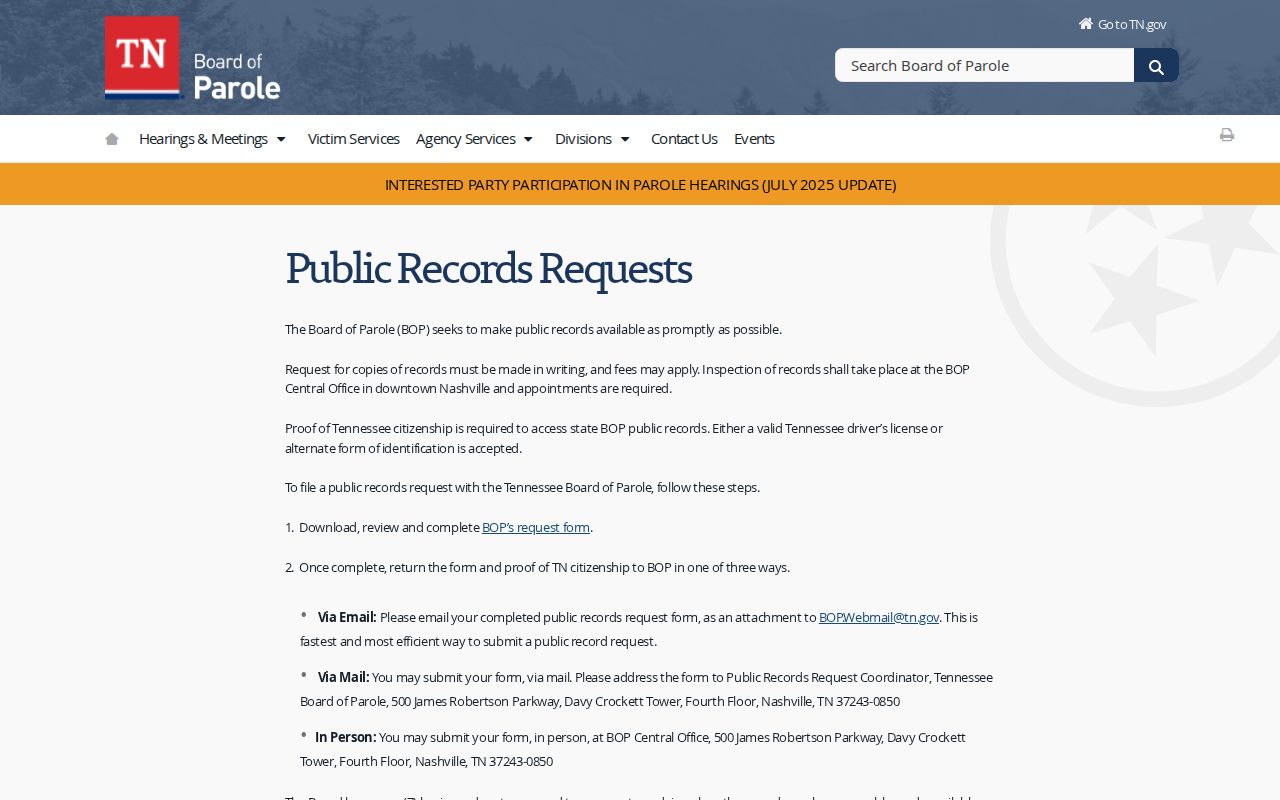
That request route is the official fallback because no separate public decisions search was verified.
Lincoln County Parole Eligibility Records
Release Eligibility Date, or RED, is calculated by TDOC. The Board’s FAQ says the trial judge imposes the sentence and classification, the statute determines the service percentage, and TDOC applies sentences and credits. RED makes a person eligible for parole consideration. It is not a scheduled release appointment and does not compel the Board to grant parole.
Eligibility depends on the offense, offense date, judgment, classification, and current law. Tenn. Code Ann. § 40-35-501 contains different release-eligibility rules and includes provisions for offenses with credit floors or full-service requirements. Sentence-reduction credits are governed in part by § 41-21-236. It is inaccurate to say every Tennessee prisoner serves the same percentage.
Appeals under § 40-28-105 may be available for significant new information that was unavailable at the hearing, substantiated misconduct by a hearing official, or significant procedural error. The Board states that an appeal request is due no later than 45 days after the offender receives the final decision. That is a procedural fact, not a prediction of the outcome.
When does release occur? Only after a final grant, satisfaction of conditions, approval of the release plan, and TDOC implementation. FOIL and the release record should then show what occurred.
Lincoln County Parole Supervision Contact
Once release occurs, TDOC provides community supervision. Lincoln County belongs to District 50, and the official field-office directory groups Lincoln with Coffee, Franklin, and Moore counties at the Tullahoma office. The Board does not perform the supervising officer’s day-to-day role.
TDOC District 50, Tullahoma703 Lakeway Place
Tullahoma, TN 37388
Phone: 931-454-1915
Fax: 931-454-1917
Lincoln-specific check-in hours: not published
FOIL is the first public status check. The field office can address permissible supervision and reporting questions. No official Lincoln County parole-warrant or absconder list was found. “Absconder” generally refers to a person alleged to have stopped reporting or complying; it is not proof of a new conviction. Use official warrant and court channels when that issue matters.
A parolee may remain under conditions until discharge. A final discharge ends supervision, while revocation may return the person to custody. Use the Board record for the decision, TDOC for supervision, and the release record for the actual end of prison custody. Keeping those roles separate prevents a hearing status from being mistaken for freedom from confinement.
No Lincoln County Parole Facility
The Tennessee Board of Parole is a decision agency, not a detention center in Lincoln County. State research identified one certified local correctional facility in the county and no TDOC facility operation. A Lincoln County conviction can still produce a state parole matter, but the prisoner may be held at any institution selected by TDOC.
A Nashville or Tullahoma building should not be implied as the place where the person was held or released. Search FOIL for the actual institution and current status. Use the Board for the hearing and decision record. Use District 50 after community release. If a detainer sends the person to another county or federal authority, follow the receiving agency.
That sequence answers the central question: a person “released by parole” goes either into approved community supervision or, when another hold controls, into the next agency’s custody. The final decision alone cannot settle which destination occurred. The Lincoln County release record path shows how the original county event connects to the later state record.
Note: State parole jurisdiction can arise from a Lincoln conviction even though no state prison or parole detention center sits in the county.