
Lincoln County VINELink Release Coverage
Tennessee SAVIN is the state’s victim information and notification layer powered through VINELink. The Tennessee Sheriffs’ Association says all 95 county sheriffs participate. County reports can include release, transfer, and escape events. The Lincoln County Sheriff links VINELink even though its own site publishes no local inmate roster or release archive. That makes VINE the main official electronic change-alert route for a local booking.
TDOC also supplies VINE data for people in Tennessee state custody. The state feed is separate from a Lincoln County jail record. A person transported from the Sheriff’s detention facility into TDOC may generate a county transfer event and later appear under TDOC. Read the reporting facility before interpreting the status.
VINELink does not cover federal BOP inmates as a general service, ICE detention as its dedicated locator, or every U.S. Marshals custody event. Those cases need the federal system that holds the record. A local release sheet can identify a receiving agency when the county event was a transfer.
The service also should not be confused with Tennessee’s conviction-specific registries. A registry entry may concern a person who must register after a qualifying conviction, and some registries can include people who are still incarcerated. VINELink answers a custody-status and notification question. It is not a list of all former inmates, and a person’s absence from it does not erase a prior booking or prove that no record exists.
Search Lincoln County Inmates on VINELink
Open the Tennessee VINELink person search. Search one person at a time. A legal name or booking or offender identifier is stronger than a loose name match. When several records appear, compare the reporting agency, facility, and available identifiers before opening a result. Do not assume the first matching name is correct.
- Select Tennessee and open Person Search.
- Enter the full name or the booking or offender identifier.
- Review possible matches and compare the reporting agency and facility.
- Open the correct record and read Custody Status.
- Note the event type, time, and reporting facility when shown.
- Call the reporting agency if the status conflicts with known facts.
The Tennessee person-search interface is shown in the successful manifest capture.
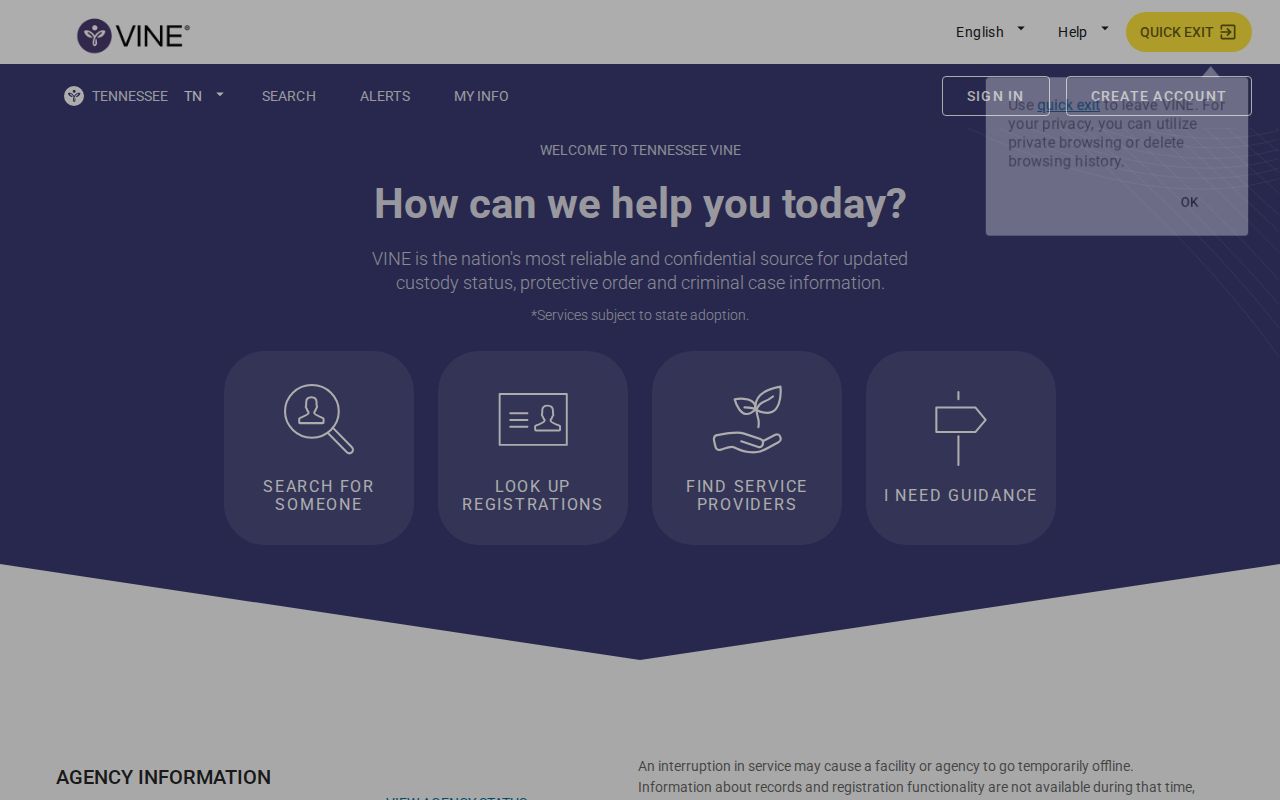
The screen is the entry point. It does not replace careful identity matching or agency confirmation.
Note: A name-only match is weak evidence; compare the facility and identifiers before relying on any Lincoln County custody result.
Lincoln County VINELink Result Fields
VINELink is a status and notification service. Its key value is the reporting agency and Custody Status for the selected person, with registration controls where available. It is not the complete Sheriff release sheet, court disposition, destination record, or TDOC sentence file. Fields vary by reporting agency and record.
| Field or action | How to read it |
|---|---|
| Name and identifier | Helps distinguish the selected person from a similar name |
| Reporting agency or facility | Shows which custody system supplied the record |
| Custody Status | States the reporting agency’s current recorded status |
| Event type | Separates release, transfer, and escape when supplied |
| Event time | Dates the reported change, subject to possible lag |
| Register/Get Notified | Starts an alert registration for the matching person |
A released or out-of-custody status supports that the named reporting agency recorded an exit. It does not prove the person is absent from all other custody. A transfer means the first agency’s custody ended while another agency may have taken control. Escape is an unauthorized departure, not lawful release.
Register Lincoln County Release Alerts
Notification registration begins on the correct matching record. Choose Register/Get Notified and select the offered phone, text, email, or in-app route. Enter the destination accurately and finish any verification prompt. Tennessee’s materials distinguish a four-digit notification PIN from a six-character account verification code.
- Open the confirmed person record.
- Select Register/Get Notified.
- Choose an available phone, text, email, or app channel.
- Enter the contact destination and choose the four-digit alert PIN when requested.
- Complete email, text, or account verification prompts.
- For a phone notice, listen and enter the PIN followed by # to acknowledge it.
The four-digit PIN tells the call system that the message was received and stops repeats. If no one answers, Tennessee says a message may be left and calls can repeat until the PIN is entered or for up to 24 hours. More than one number or email can be registered when the service offers that option.
Do not share a PIN with people who should not control the alert. Keep the person record and reporting agency noted so a later message can be interpreted. A transfer alert calls for a search of the receiving system, while a release alert calls for confirmation of the release type and destination.
Lincoln County SAVIN Callback Pattern
The callback design is a distinctive Tennessee feature. All counties participate, and Lincoln County directly promotes VINELink despite having no local web roster. An unanswered notification can repeat for as long as 24 hours unless the four-digit PIN is entered. That repeat pattern is meant to improve delivery, not to signal several separate custody events.
The Tennessee Sheriffs’ Association SAVIN page also lists the toll-free search and operator line, 1-888-868-4631, and TTY line, 1-866-847-1298. Operator help is available around the clock. Use it when online access fails or registration needs help.
Account verification and alert acknowledgment serve different functions. A six-character code can verify an online account. The four-digit PIN plus the pound sign acknowledges a telephone status notice. Mixing the two can leave repeat calls active or prevent account setup.
Note: Repeated calls usually mean the alert has not been acknowledged, not that Lincoln County reported the same release more than once.
Lincoln County and TDOC VINE Records
For a local booking, choose the Lincoln reporting agency and confirm the event with the Sheriff’s detention facility. The detention number is 931-433-3111. If the county entry says transfer, ask for the receiving agency. A transport to TDOC closes the local booking but does not return the person to the community.
For a state prisoner, use the TDOC VINE result together with TDOC FOIL. FOIL covers current and former Tennessee felony offenders and may show incarcerated, parole, probation, or inactive status, plus location, sentence, hearing, and release information. VINE is better for a change alert. FOIL is better for the continuing state summary.
| Person’s path | Primary check | Confirmation |
|---|---|---|
| Lincoln County jail booking | Lincoln agency result in VINELink | Sheriff release entry and court order |
| Transferred to TDOC | TDOC VINE result | FOIL status and state record |
| TDOC release under county detainer | TDOC event, then receiving county SAVIN | Receiving county’s later event |
| Federal BOP custody | BOP inmate locator | BOP record or FOIA route |
If TDOC releases a person under a county detainer, register in the receiving county’s SAVIN system. Do not describe the person as in the community until the receiving agency also records a lawful release.
Lincoln County VINELink Search Limits
A no-match has several possible causes. The spelling or identifier may be wrong. The reporting source may be delayed, offline, or outside the system. An older record may no longer display. None of those outcomes proves release. Retry with the exact name or booking number, check the state selection, and call the likely facility.
Data can lag behind a physical event. A new release may take time to reach the public record, while a transfer can briefly look like the end of custody at the first agency. Record the timestamp shown and compare it with the Sheriff, TDOC, or court record. For a durable multi-system search, the Lincoln County release record route sets out the local, state, court, and federal paths.
VINELink is not a parole decision database. The Tennessee Board of Parole decides parole, and TDOC supervises after release. It is also not a court docket or an official release-order copy. Those records must be requested from the agency that created them.
Older events have different limits in other systems. The ICE public locator includes people released from ICE custody only during the prior 60 days. The BOP locator covers federal inmate records from 1982 forward and can show a RELEASED status with a past date. A U.S. Marshals pretrial event may require the federal docket, the actual custodial jail, BOP after commitment, or a records request. Those routes do not belong inside a Tennessee VINELink search result.
Confirm Lincoln County Release Alerts
After a release alert, ask four questions: who was involved, which custody episode ended, when and by what authority it ended, and where the person went. The Sheriff booking/release sheet can supply the event. The court file can show bond, dismissal, judgment, sentence, or another order. For a transfer, the receiving system supplies the next status.
A phone alert is useful for quick notice. Keep its event time and reporting agency. Then confirm before making plans based on the event. A person released from the Lincoln County jail can still be held by TDOC, ICE, another county, or federal authorities. A person released by TDOC may still face community supervision or a detainer.
When a durable local copy is needed, ask LCSO for the adult booking/release sheet or jail-register entry tied to the precise booking episode. Requested fields can include the booking number, commitment and release times, release type, releasing facility, destination or receiving agency, and order reference. Tennessee’s retention schedule describes the jail register and its release date as permanent, so the record can remain useful after an alert has passed from view.
- Release
- The reporting agency records that its lawful custody ended.
- Transfer
- Custody shifts from one agency or facility to another.
- Escape
- An unauthorized departure, not a release.
- Custody Status
- The status reported by the named agency, not a universal national result.
- Detainer
- A request or authority that can lead to another agency taking custody.